
"BOOSTERGUARD"
The First & Only Universal Booster Seat Cover
If you’ve ever used five wipes to “sanitize” a restaurant booster seat and still thought, yeah… that’s probably carrying E. coli, you’re not alone. BoosterGuard was created by parents who’ve done the awkward wipe-down, crossed their fingers, and hoped for the best. It’s a simple, universal cover that adds a clean barrier between your child and whatever that seat has lived through before.
Quality you can trust: Designed by parents, verified by CPSC-accepted labs, built to meet applicable CPSIA children’s product safety standards.


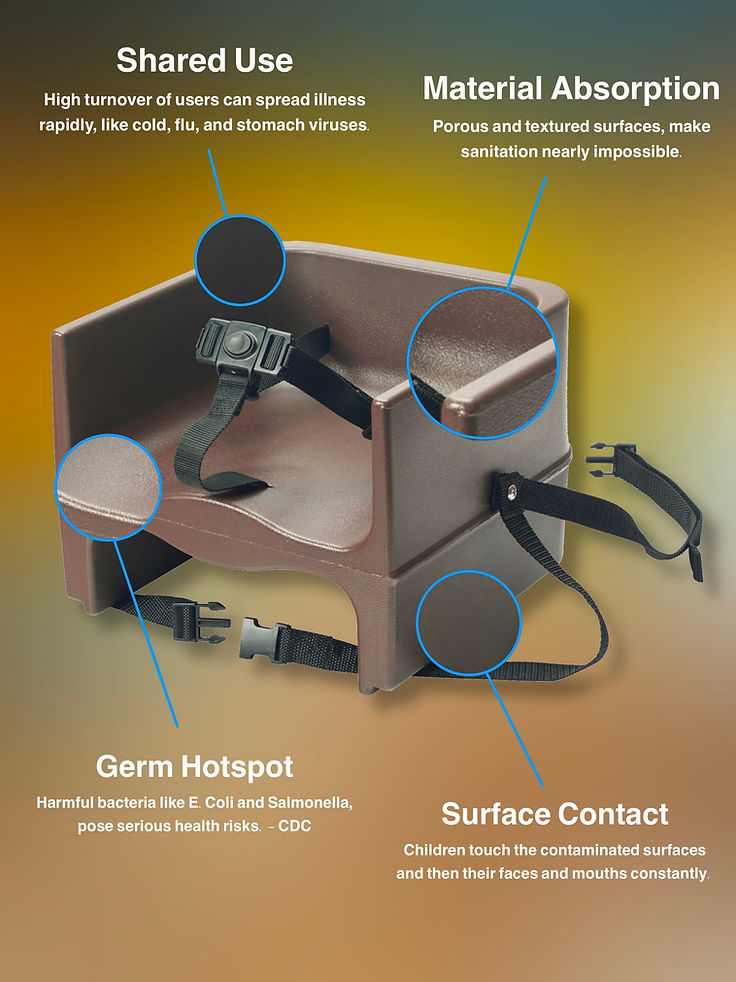
The Uncomfortable Truth About Public Booster Seats
Public booster seats look harmless.
But research shows they’re anything but clean.
Independent testing of restaurant seating surfaces has found that booster seats can carry microbial contamination levels exceeding 100 colony-forming units (CFU) per 100 cm² — a benchmark commonly used to flag surfaces as heavily contaminated. In some swab studies of restaurant high chairs and booster seats, bacterial counts averaged over 140 bacteria per square centimeter, with organisms including E. coli and Staphylococcus species detected.
To put that into perspective: these are high-touch surfaces used by hundreds of children, day after day — yet they are not subject to the same cleaning regulations as food-prep areas.
And bacteria is only part of the story.
According to the CDC, norovirus — one of the most common causes of stomach illness in children — can survive on hard surfaces for days or even weeks, and is resistant to many common disinfectants. Even more concerning, research shows that as few as 18 viral particles may be enough to cause infection.
That means:
-
A surface can look clean and still carry risk
-
A quick wipe may not be enough
-
And you have no real way of knowing what’s been left behind
When you’re handed a booster seat in a restaurant, there’s no label.
No cleaning log.
No guarantee of when — or how — it was last sanitized.
You’re trusting that:
-
The last child wasn’t sick
-
The seat was cleaned properly
-
The wipe used was actually effective
That’s a lot of uncertainty — especially when it comes to kids who touch everything, put their hands in their mouths, and don’t exactly practice perfect hygiene.
This isn’t about being paranoid.
It’s about acknowledging what the data already shows:
Shared public seating surfaces can carry measurable contamination, cleaning practices vary widely, and some viruses persist far longer than most people realize.
For parents, that translates into one feeling:
loss of control.
And once you notice it, you can’t un-notice it.
But What About Sanitizing & Disposable Wipes?
Most parents do.
And most parents still feel unsure afterward.
Here’s why.
1. Sanitizing wipes aren’t designed for heavy, repeated public-use surfaces
According to CDC guidance, some viruses (including norovirus) can survive on surfaces for days to weeks and are resistant to many common disinfectants. In fact, the CDC notes that effective disinfection for certain pathogens often requires bleach-based solutions at specific concentrations and contact times — not a quick wipe-and-go.
Most sanitizing wipes:
-
Are used for seconds, not minutes
-
Don’t meet recommended contact times
-
Are designed for light household use, not high-traffic public seating
-
A wipe may spread contamination rather than remove it
-
You don’t know what was there before you wiped
-
You don’t know whether the wipe you used was effective for that surface
-
Parents are left relying on guesswork, not certainty.
So while wipes can help, they don’t guarantee the surface underneath is truly addressed — especially on textured plastic, seams, or crevices common in booster seats.
.
2. Chemical exposure adds another layer of concern
Many disinfecting wipes contain:
-
Quaternary ammonium compounds
-
Alcohols
-
Fragrances and preservatives
While these are approved for general cleaning, they’re not designed with repeated skin contact for young children in mind, especially on surfaces kids touch with their hands, mouths, and faces immediately after use.
For parents trying to limit unnecessary chemical exposure, this creates another uncomfortable tradeoff:
“Is the wipe safer — or is what’s left behind another issue?”
3. The environmental cost adds up fast
Sanitizing wipes are:
Single-use
Non-recyclable
Often made from plastic-based fibers
During peak usage periods, billions of wipes are discarded annually, contributing to landfill waste and sewer clogs (even “flushable” wipes).
Using wipes at every meal, outing, or travel stop adds up — financially and environmentally — without actually solving the underlying uncertainty.
Why a Reusable Barrier Changes the Equation
A reusable cover doesn’t claim to disinfect anything.
It doesn’t promise sterility.
And it doesn’t replace good hygiene.
What it does is remove the unknown.
Instead of:
-
Wondering how well a surface was cleaned
-
Relying on a single wipe and hope
-
Exposing your child to a rotating mix of chemicals
You create a consistent, reusable layer between your child and a shared public seat — every time.
Same surface.
Same routine.
No guesswork.
Wipes try to fix an invisible problem after it already exists.
A reusable solution avoids the problem altogether.
For parents, that difference matters.

